A great coffee processing plant is not just about having the right machines. The real advantage comes from how you arrange them, how materials move, and how you prevent small operational problems from turning into quality losses, delays, or safety risks.
At Le Green Coffee, we work closely with farmers and processing partners across Indonesia, so we see the same pattern again and again: when the layout is clear and the workflow is logical, the operation becomes faster, cleaner, and easier to manage. This guide breaks down an ideal processing layout and workflow for turning coffee cherry or parchment into green beans, based on proven post-harvest principles.
Why layout and workflow matter in coffee processing
A processing plant layout affects almost everything:
• Operational efficiency: Less unnecessary movement means less time, less labor, and fewer bottlenecks.
• Cost control: A smoother flow reduces handling, rework, and equipment downtime.
• Food safety and contamination prevention: Clear separation between “dirty” and “clean” activities reduces cross-contamination risk.
• Worker safety: Better access, clearer paths, and fewer crossing routes reduce accidents.
For buyers evaluating an Indonesian Coffee Supplier, a well-designed facility is also a strong credibility signal. It shows the supplier understands process discipline and can deliver consistently.
Core principles for a strong processing plant layout
Before we talk about machines, start with these design rules.
1) One-way, linear flow
Aim for one-way flow where raw material enters one side and finished product exits the other. Avoid backtracking to reduce handling errors, confusion, and traffic congestion.
2) Separate dirty and clean zones
Coffee cherry and parchment handling produces moisture, pulp, mucilage, dust, and waste, so green bean sorting and packing must be kept in a clean area. The key principle is physical separation to protect quality and workflow: dirty zone for receiving, pulping, fermentation, washing, and drying; transition zone for hulling and early separation; and clean zone for grading, sorting, packing, and finished goods storage.
3) Easy Access for Trucks, Forklifts, and Maintenance
Coffee grows in stages, so your layout should allow future expansion like more drying, sorting, storage, and loading capacity. Keep extra space near the packing and warehouse area at the end of the flow.
4) Flexibility for future expansion
Coffee businesses grow in stages, so the layout should allow expansion such as more drying capacity, sorting lines, storage, and loading capacity. Leave extra space at the end of the flow, especially near packing and warehouse areas.
5) Ventilation, lighting, and drainage
Processing creates moisture and dust that must be managed in the design. Wet areas need drainage and airflow, dry milling needs dust control and ventilation, and manual sorting needs strong, comfortable lighting.
The ideal processing plant layout by zone
Below is a practical layout structure that works for many Indonesian coffee contexts.
Zone 1: Receiving and pre-processing (dirty zone)
This is where coffee enters your facility. The goal is to receive quickly, reduce waiting time, and remove obvious contaminants early.
• Step 1: Receiving and Weighing
The receiving and weighing area is the entry point for all coffee and should include truck access, a scale, and a staging area for sacks or bins. Placing it near the entrance reduces internal truck movement and improves overall efficiency.
• Step 2: Initial Sorting
After receiving, coffee goes through initial sorting using tables or a conveyor where leaves, twigs, stones, debris, and damaged cherries are removed. This early step helps prevent problems in later processing stages.
• Step 3: Pulping
For coffee cherry processing, pulping should be located close to receiving to reduce delays. Faster transfer from delivery to pulping helps prevent unwanted fermentation and improves quality control.
• Step 4: Fermentation or Demucilaging
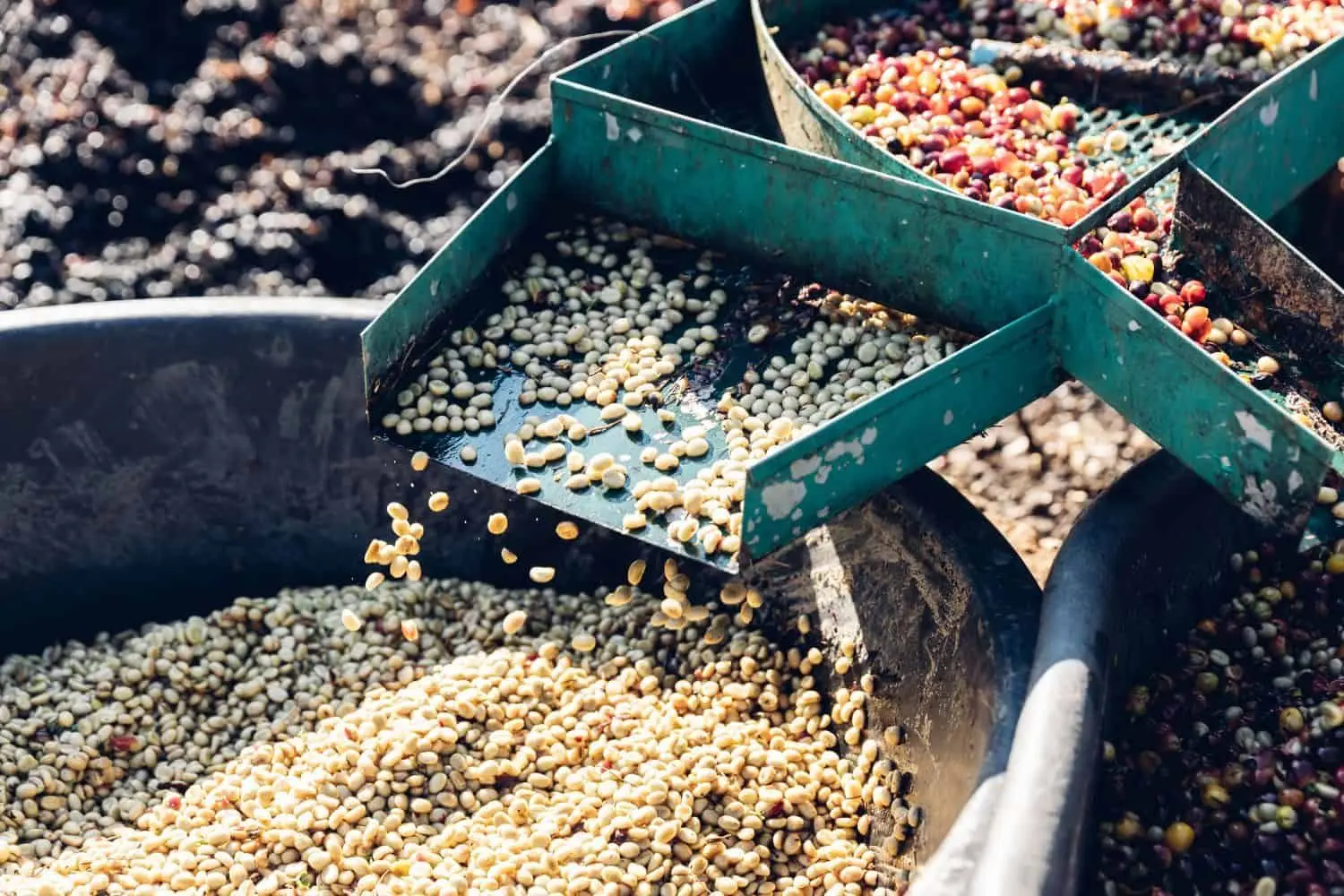
After pulping, coffee undergoes fermentation or mechanical demucilaging to remove mucilage. This area must have good water access, drainage, and cleanable surfaces to ensure consistent and hygienic processing.
• Step 5: Washing
Washing is done immediately after fermentation or demucilaging using channels or tanks with a direct flow system. A short and efficient layout reduces handling time and helps maintain coffee quality.
• Step 6: Drying Area
Drying is the largest processing area and can use patios, covered structures, or mechanical dryers. It must be well organized so wet coffee does not pass through clean zones, reducing contamination risk.
• Step 7: Parchment Storage
Once dried, coffee is stored as parchment in a dry, cool, ventilated, and pest-free area. This storage acts as a buffer between drying and dry milling while supporting proper stock rotation.
Zone 2: Hulling and Early Separation
This zone converts parchment into green beans and must be controlled due to dust, husk, and waste. It requires good housekeeping, and separation from cleaner areas.
• Step 8: Hulling
Hulling should be next to parchment storage to reduce transport and keep a linear flow. It also needs husk collection, clear waste routes, and easy-to-clean surfaces.
• Step 9: Separation and Destoning
After hulling, coffee goes through separation and destoning to remove husk, stones, and heavy contaminants, protecting equipment and ensuring only clean green beans continue.
Zone 3: Sorting, Packing, and Finished Goods (Clean Zone)
Zone 3 is the most controlled area, where green coffee is prepared for sale and shipment. It must be clean, organized, and protected from dust and moisture to maintain quality.
• Step 10: Size Grading
Coffee is first sorted by size using screens or grading machines. This creates uniform lots and improves the efficiency and accuracy of later sorting steps.
• Step 11: Density Sorting
After sizing, coffee goes through a gravity separator to remove light and defective beans. This improves consistency and overall lot quality.
• Step 12: Color Sorting
Color sorting removes visual defects using optical machines. A clean, dust-free environment with stable lighting is essential for accurate performance.
• Step 13: Manual Sorting
Manual sorting is the final quality check where workers remove remaining defects. It requires good lighting, ergonomic stations, and clear separation between accepted and rejected beans.
• Step 14: Packing and Bag Closing
Sorted coffee is weighed, filled, sealed, and labeled in a dedicated packing station. Organized material storage and a direct workflow help reduce handling and maintain cleanliness.
• Step 15: Finished Goods Warehouse
Packaged coffee is stored in a dry, ventilated warehouse with pallets and FIFO rotation. The space should support easy forklift access and organized inventory control.
• Step 16: Loading Bay
The loading bay is the final step for shipment, designed for truck access, forklift movement, and weather protection. It ensures efficient and clean transfer of goods to transport vehicles.
Process Flow Summary
The ideal workflow follows a linear path from receiving to shipment: receiving and weighing, sorting, pulping, fermentation or demucilaging, washing, drying, parchment storage, hulling, separation and destoning, size grading, density sorting, color sorting, manual sorting (if required), packing, finished goods storage, and loading. This streamlined layout reduces handling, improves efficiency, and helps maintain coffee quality throughout the process.
How Le Green Coffee approaches processing partnerships
Le Green Coffee works with producers to improve post-harvest systems and design efficient workflows based on volume, process, and market goals. For buyers seeking an Indonesian coffee supplier, the focus is a clean flow from origin to shipment. Contact Le Green Coffee with your volume, origin, and processing details.